Native Fish
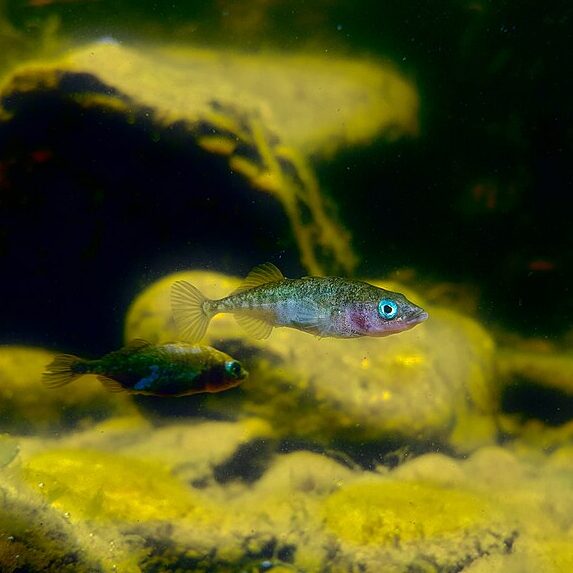


The most abundant native fishes present in streams within the area of focus include the California Roach, Three-Spined Stickleback, Rainbow Trout/Steelhead, Sacramento Sucker, Pricky Sculpin, Sacramento Pikeminnow, Lampetra spp., and Pacific Lamprey.
What metrics determine the health of this indicator?
Metric 1
The presence and persistence of fish species as measured by the percent of species surveyed that were native by year and by watershed. The baseline for this metric was set using data from 2010–2019.
Caution
Unchanging
Moderate Metric 1
The presence and persistence of fish species as measured by the percent of species surveyed that were native by year and by watershed. The baseline for this metric was set using data from 2010–2019.
Geographic Area


Condition Thresholds
Good
All fish species sampled during stream surveys over a 10-year period are native.
Caution
A combination of native and non-native fish species are sampled over a 10-year period.
Significant Concern
None of the fish species sampled during stream surveys over a 10-year period are native.
Metric Current Health Findings
Current Condition
The current condition for all watersheds is Caution.
- Pinole Creek watershed: Caution. While generally dominated by natives, a combination of native and non-native fishes was sampled over the 10-year period.
- Wildcat Creek watershed: Caution. A combination of native and non-native fishes was sampled over the 10-year period.
- San Leandro Creek watershed: Caution. A combination of native and non-native fishes was sampled over the 10-year period in lower San Leandro Creek. Upper watershed creeks are completely dominated by native fish species.
- Alameda Creek watershed: Caution. A combination of native and non-native fishes was sampled over the 10-year period.
Current Trend
All trend for all watersheds is Unchanging. The number of native fish species sampled during stream surveys over the 10-year period did not change.
Current Confidence
The current confidence for all watersheds is Moderate.
- Pinole Creek watershed: Low. Surveys were not conducted every year of the 10-year period. The maximum number of survey sites (n=3) for each year was small compared to other watersheds, and those sites focused on the middle- to upper watershed. Surveys did not capture the status of native or non-native species in the lower watershed.
- Wildcat Creek watershed: Moderate. Surveys were conducted nine years of the 10-year period. The maximum number of survey sites (n=28) provided additional confidence for this watershed.
- San Leandro Creek watershed: Moderate. Surveys were conducted for every year of the 10year period. Most of the survey sites (n=17 of 20) in this watershed are limited to upper watershed streams. Few surveys (n=3) are conducted in the lower watershed.
- Alameda Creek watershed: High. Surveys were conducted every year of the 10-year period. All surveys (n=16) are conducted in upstream areas, with survey sites in headwater streams (La Costa, Indian, and Stonybrook creeks), and in Alameda Creek upstream of its confluence with Calaveras Creek, with largely intact native fish populations.
Rationale - Why It's Important
The presence of native fish populations indicates intact fish communities and associated suitable habitat conditions. Non-native fishes indicate disturbed aquatic ecosystems and altered food webs via competition and predation. This metric captures the species richness of native and non-native fishes by measuring the number of species within an area. With this, we can show the presence and persistence of both native and non-native fish species. This count of species presence can indicate intrusion by non-native fishes from reservoirs or the loss of a native fishes from the community. By considering trends over several years, we can look at the persistence of non-native fish, often swept downstream by rain events from reservoirs. These non-native fishes are often found just downstream of reservoir spillways and are not likely to persist in the stream habitats in the long-term.
Goal
Maintain or increase the native fish species richness within a watershed.
Baseline Description
Calculated annually for 10 years per watershed.
- Pinole Creek watershed: Pinole Creek was the only stream surveyed within the Pinole Creek watershed. There were four native fish species and only one non-native fish species, with an individual Bluegill collected in 2017. Non-native fish species, which are generally absent from the upper watershed, are mostly found in the lower reaches, particularly downstream of Highway 80.
- Wildcat Creek watershed: Wildcat Creek was surveyed nine years during the 10-year period. Three native and three nonnative fish species were caught. The three non-native fish species are members of the Centrarchidae family, which had been previously stocked in Jewel Lake and Lake Anza, both man-made reservoirs within the watershed. Jewel Lake dried in 2016 and subsequent years, but populations of sunfish and bass in Lake Anza continue to reproduce, and some of these fish are swept downstream into Wildcat Creek during high-flow events.
- San Leandro Creek watershed: Kaiser Creek, Moraga Creek, Redwood Creek, Rimer Creek, San Leandro Creek below Lake Chabot, Upper San Leandro Creek were surveyed every year during the 10-year period. Four native and five non-native fish species were caught in this watershed. All non-native fish species caught in the watershed were collected below Lake Chabot Dam. There are no non-native fishes above Upper San Leandro Reservoir in any of the headwater streams.
- Alameda Creek watershed: Upper Alameda Creek, La Costa Creek, Indian Creek, Arroyo Hondo, Lower Alameda Creek, Lower Calaveras Creek, and Stonybrook Creek was surveyed during the entire 10-year period. Eight native and four non-native fish species were caught within the watershed. Non-native fish species were collected from three of six streams during the 10-year period. All instances of non-native fishes collected in the Alameda Creek watershed over the 10-year period were from Lower Alameda Creek or Calaveras Creek, downstream of Calaveras Reservoir.
Metric 2
The percent composition of fish species that were native as measured by year and by watershed. The baseline for this metric was set using data from 2010–2019.
Caution
Unchanging
Moderate Metric 2
The percent composition of fish species that were native as measured by year and by watershed. The baseline for this metric was set using data from 2010–2019.
Geographic Area

Condition Thresholds
Good
The relative abundance of individual non-native fishes has a declining trend and individual non-native fishes are not regularly observed. For the purposes of this analysis, “not regularly observed” is defined to mean 20% or fewer of the years sampled. This definition was chosen because it addresses transitory conditions, such as when a spill from a reservoir results in observations of non-native fish, but the fish do not persist in the stream.
Caution
The relative abundance of individual non-native fishes does not have an improving or declining trend, with non-native individuals regularly observed.
Significant Concern
The relative abundance of individual non-native fishes has an improving trend, with non-native individuals regularly observed.
Metric Current Health Findings
Current Condition
The overall condition for all watersheds is Caution.
- Pinole Creek watershed: Good. The relative abundance of non-native fish individuals has a declining trend, and non-native fish individuals are not regularly observed. One individual non-native fish was collected in 2017, but subsequent surveys have not detected additional non-native fishes.
- Wildcat Creek watershed: Caution. The relative abundance of non-native fish individuals does not have an improving or declining trend.
- San Leandro Creek watershed: Caution. The relative abundance of non-native fish individuals does not have an improving or declining trend. Upper watershed creeks are completely dominated by native fish species.
- Alameda Creek watershed: Caution. The relative abundance of native fish individuals is high every year, and the ratio of native to non-native fishes does not have an improving or declining trend, but non-native individuals are regularly observed.
Current Trend
The overall trend for all watersheds is Unchanging.
- Pinole Creek, Wildcat Creek, and San Leandro Creek watersheds: Unchanging. The number of native fishes sampled during stream surveys over the 10-year period did not change.
- Alameda Creek watershed: Unchanging. The ratio of native to non-native fish individuals sampled during stream surveys over the 10-year period did not change.
Current Confidence
The current condition for all watersheds is Moderate.
- Pinole Creek watershed: Low. Surveys were not conducted every year of the 10-year period. The maximum number of survey sites (n=3) for each year was small compared to other watersheds, and those sites focused on the middle to upper watershed. Surveys did not capture the status of native or non-native species in the lower watershed.
- Wildcat Creek watershed: Moderate. Surveys were conducted every year of the 10-year period, but the number of sites surveyed fluctuated (Low n=17; High n=28), and the numbers of native fishes decreased during drought years.
- San Leandro Creek watershed: Moderate. Surveys were conducted every year of the 10-year period, but the number of sites surveyed fluctuated (Low n=9; High n=20), and the numbers of native fish decreased during drought years.
- Alameda Creek watershed: High. Surveys were conducted every year of the 10-year period, but the number of survey sites fluctuated (Low n=6; High n=16), and the number of native fishes decreased during drought years. However, the watershed-wide sampling effort remained robust enough to support an overall high level of confidence.
Rationale - Why It's Important
The presence of native fish populations indicates intact fish communities and associated suitable habitat conditions. Non-native fish populations indicate disturbed conditions and disruptions to aquatic ecosystems through competition and predation. This metric captures the relative abundance of native and non-native fishes as measured by the percent composition of a sampled population. We can use relative abundance to show how dominant native species are in a given watershed. Over time, this trend shows the resiliency of the native fish community to drought and non-native fishes.
Goal
Maintain or increase the relative abundance of native fish individuals within a watershed.
Baseline Description
Calculated based on annual data collections (with a few gaps) over 10 year period per watershed.
- Pinole Creek watershed: The vast majority of all fishes caught in this watershed are native, with just one non-native Bluegill caught in 2017.
- Wildcat Creek watershed: Wildcat Creek was surveyed nine years during the 10-year period. During the 10-year period, native species were generally more than 95% of fish surveyed each year.
- San Leandro Creek watershed: Greater than 99% of all fish collected during the annual surveys were native species. All the non-native fishes caught in the San Leandro Creek watershed were collected below Lake Chabot Dam. There are no non-native fishes above Upper San Leandro Reservoir in any of the headwater streams.
- Alameda Creek watershed: Greater than 99% of the fishes collected from the Alameda Creek watershed each year were native. Three of six streams surveyed within the watershed had non-native individual fishes during the 10-year period. All instances of non-native fishes collected in the Alameda Creek watershed from 2010 to 2019 were from Lower Alameda Creek or Calaveras Creek, downstream of Calaveras Reservoir.
About this Indicator
Stream channelization as well as impoundments, diversions, and other in-channel barriers have dramatically altered East Bay watercourses’ hydrology and habitats. NatureCheck evaluates the desired condition of fish populations in the context of these current realities as opposed to using historical conditions as a goal or baseline. A primary goal of the analysis is to provide a benchmark against which managers can measure future changes and understand the likely trajectories of fishes in watersheds within the area of focus. The baseline data and analyses can also be used to identify restoration projects or management actions that have the potential to achieve multiple benefits. The evaluation, which only uses available data, also identifies areas where not enough is known to draw meaningful conclusions. Opportunities for future research and collaboration between land managers are also presented.
Why is This Resource Included?
Streams in the East Bay, including those within the area of focus historically provided suitable habitat for a variety of native fish assemblages (Leidy 2007, 2011). The makeup of fish assemblages, however, can be impacted by natural and human-induced environmental changes, including the introduction and establishment of non-native species. Therefore, an examination of stream-fish communities—specifically, their richness and the relative abundances of native and non-native species—can be used as an indicator of stream health. Undisturbed streams and reaches are generally characterized by the complete absence of non-native species, while disturbed streams and reaches generally have an abundance of one or more non-native fish species (Leidy and Fiedler 1985).
Desired Condition and Trend
The desired condition is to maintain or increase the native fish species richness and the relative abundance of native fish individuals in streams managed by Network partner agencies, and the desired trend is for native fish populations to be resilient over time (i.e., an unchanging or improving trend would indicate that they are able to persist through and recover after periods of stress, such as drought and climate change). Measuring species richness, or the number of species within an area, can show the presence and persistence of both native and non-native fish species. Species presence counts can indicate intrusion by non-native fishes from reservoirs or the loss of a native fish species from the community. The relative abundances, or the percent composition of a sampled population, can be used to show how dominant native species are in a given watershed. Over time, this trend shows the resiliency of the native fish community to drought and non-native fishes.
Current Condition and Trend
Streams within the area of focus, which can be ephemeral, seasonal, intermittent, or perennial, typically support multiple native and non-native fish species. The East Bay’s native fishes live in numerous habitat types, starting in steep, rocky headwaters, moving through meandering channels with gentle slopes, and into wider, slower-flowing depositional areas before emptying into the greater San Francisco Bay. The aquatic landscape within the area of focus has changed dramatically over time, but despite reservoir and diversion construction, urbanization, and habitat loss, streams managed by Network partner agencies continue to support native fish populations. During the 2014-2016 drought, the number of native fish species held steady, although there were abundance decreases. Community numbers rebounded after above-average rains in 2017.
The most abundant native fishes present in streams within the area of focus include the California Roach (Hesperoleucus symmetricus), Three-Spined Stickleback (Gasterosteus aculeatus), Rainbow Trout/Steelhead (Oncorhynchus mykiss), Sacramento Sucker (Catostomus occidentalis), Pricky Sculpin (Cottus asper), Sacramento Pikeminnow (Ptychocheilus grandis), Lampetra spp., and Pacific Lamprey (Entosphenus tridentatus). Non-native fish species include the Largemouth Bass (Micropterus salmoides), Smallmouth Bass (Micropterus dolomieu), Bluegill (Lepomis macrochirus), Green Sunfish (Lepomis cyanellus), Black Crappie (Pomoxis nigromaculatus), Goldfish (Carassius auratus), and Common Carp (Cyprinus carpio). The East Bay Regional Park District (EBRPD), East Bay Municipal Utility District (EBMUD), and San Francisco Public Utilities Commission (SFPUC) conduct annual surveys to document and assess native fish populations and provide data to assist in stream habitat management. Fishes can move within connected streams and their tributaries and use different habitats for multiple life stages. Consequently, surveyed streams are grouped and evaluated at the watershed level. Pinole Creek, Wildcat Creek, and San Leandro Creek watersheds are located entirely within the East Bay Hills subregion. The majority of the Alameda Creek watershed is located within the Mt. Hamilton subregion, while the portion downstream (west) of Highway 680 (including Stonybrook Creek) is in the East Bay Hills subregion. No streams within the Mt. Diablo Range subregion were included in this analysis because Network partner agencies do not conduct fish surveys in the subregion.
These metrics give us a way to measure the difference between what is described in this section (i.e., how things are now) and the desired condition and trend in the preceding section (i.e., what we think “healthy” is for this indicator).
Stressors
Climate Change
Climate change is altering hydrologic conditions, warming water temperatures, decreasing water quality, lowering dissolved oxygen levels, increasing the frequency of droughts, and causing more dramatic or unseasonable rain events (when they do occur). Periods of drought can also reduce spawning and rearing habitat, lessen habitat connectivity and in-stream mobility, and decrease food resources.
Direct Human Impacts
People, dogs, or cattle entering a stream can cause the direct loss of spawning habitat, harm fish, and change both stream and adjacent riparian habitat. The loss of native tree canopies can increase water temperature, evaporation rates, and stream turbidity. Although much of the stream habitat in the area of focus is within open space managed and protected by Network partner agencies, upstream private parcels and downstream areas could experience heavy fishing pressure. Illegal poaching can also occur on Network partner agency lands.
Disease
The native-fish-community surveys conducted in the area of focus are not designed to detect or monitor diseases. However, we know climate change makes fish populations more susceptible to bacterial, viral, and fungal infections (Chiaramonte et al. 2016).
Habitat Disturbance/Conversion/Loss
Although much of the stream habitat in the area of focus is within open space managed and protected by the Network partner agencies, many downstream areas have been heavily modified (e.g., channelized streams, passage barriers), lack riparian vegetation, and are subject to urban runoff.
Invasive Species Impacts
Non-native wildlife (i.e., American bullfrogs [Lithobates catesbeianus], centrarchids [sunfish and bass species]) can prey upon native fish and can lead to a loss of native fish biodiversity if they outcompete native species (Bunnell and Zampella 2008).
Passage Impediments/Barriers/Reservoirs
The presence of reservoirs and passage barriers on the landscape can have detrimental effects on native fishes. Populations can become isolated from one another, which could increase the potential risk of small populations dying out during a drought or decrease genetic diversity, making them more vulnerable to diseases. Most reservoirs in the area are also home to reproducing populations of non-native warmwater fishes, which often get pulled in or over dam spillways into streams below.
Pollution/Contaminants
Toxic substances from spills or runoff can enter streams and reservoirs directly or through storm drains, resulting in direct harm to aquatic species and their habitat. Mercury from old mines, which continues to seep into water bodies, bioaccumulates up the food chain. Longer-living or predatory fish can contain elevated levels of mercury, which can be harmful to humans or wildlife when consumed in high amounts.
Sedimentation/Excess Sediment Load
Excessive sedimentation (e.g., as a result of increased intermittent flow from altered weather patterns, increased erosion from recreational trail usage, increased development, lack of riparian vegetation) alters and reduces usable fish habitat by increasing the proportion of fine sediment in riffles and filling pools. Fine sediments also have the potential to affect fish forage by either reducing benthic macroinvertebrate densities or altering community characteristics (Scheurer et al. 2009).
Additional Resources
Other Metrics Considered but Not Included
- Several metrics, including growth rate and condition-factor calculations, parasite presence/absence, and stream health and condition were considered, but the lack of consistent, complete datasets for native fishes for all watersheds and for all years prevented us from being able to analyze these metrics.
- We also considered separating watersheds by cold- versus warm-water reaches, to show that non-native fishes are typically found in lower, warmer-water parts of the watersheds, but a lack of survey data for these areas prevented this approach.
Data Gaps and Data Collection/Management Needs
- Fish survey data is not available for all primary and secondary streams within the area of focus.
- Only portions of stream reaches were surveyed, so fish community variability for an overall reach or stream may not be suitably captured.
- Age and growth, weight, and parasite data for native species are only available for Steelhead (Rainbow) Trout (Oncorhynchus mykiss).
- Stream habitat quality data of sufficient detail to document stream health and condition are lacking.
- Data for warm- and cold-water reaches or streams are not evaluated independently.
Past and Current Management
Some partner agencies conduct annual native fish population monitoring by doing stream electrofishing surveys (EBRPD, EBMUD, SFPUC). EBMUD participated in the Pinole Creek Fish Passage Improvement Project, which included the removal of a migration barrier under Interstate 80, which now allows Steelhead access to upstream areas under most flow conditions. This project has also likely increased mobility for other native fish species in the lower watershed. Projects in Alameda Creek watershed are underway (or have been completed) to restore complete volitional anadromy to some of the watershed’s upper reaches.
Potential Future Actions
- Coordinate among Network partner agencies on data collection and use methods.
- Network partner agencies to continue to work together to coordinate and share data.
- Identify opportunities for enhancing fish-bearing stream habitat and the removal of fish barriers.
Key Literature and Data Sources
For additional information about this indicator including key literature and data sources see NatureCheck