Birds – Grassland
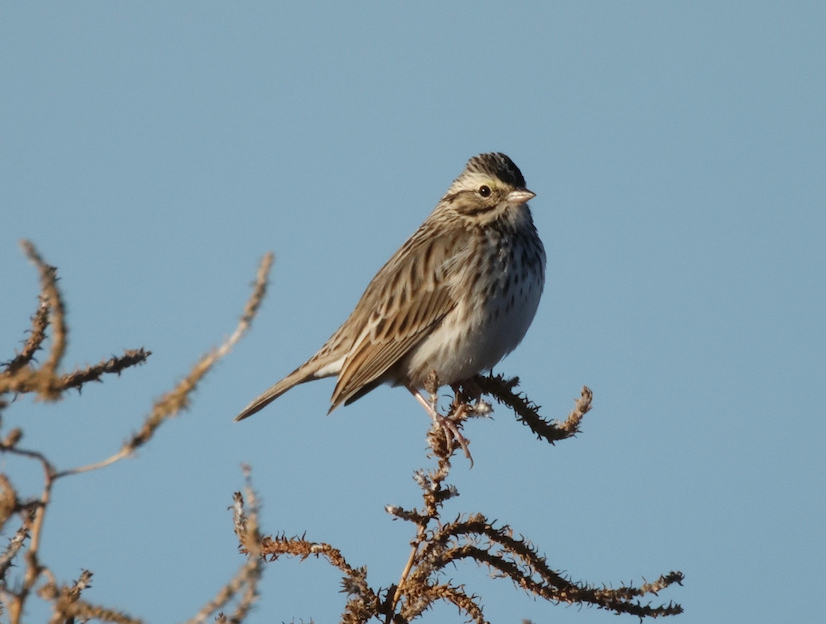


The grassland bird guild is made up of seven species that are typically found in grasslands: grasshopper sparrow, horned lark, loggerhead shrike, northern harrier, savannah sparrow, western meadowlark, and white-tailed kite.
What metrics determine the health of this indicator?
Metric 1
Using all locations where any eBird observer recorded the presence or absence of the focal species, we measured the fraction of occupied sites from 2010 to 2020. Sites were 1- or 4-hectare grid cells (grid-cell size depended on the size of the bird’s territory).
Representative Species
Significant Concern
Declining  Moderate
Significant Concern
Declining
Moderate
Moderate
Significant Concern
Declining
Moderate  Good
Good  Unchanging
Low
Good
Unchanging
Low
Unchanging
Low
Good
Unchanging
Low  Caution
Unchanging
Moderate
Caution
Declining
Moderate
Good
Caution
Unchanging
Moderate
Caution
Declining
Moderate
Good  Improving
  High
High
Metric Current Health Findings
Current Condition
A condition was assigned to each species based on the combined trends of the presence/absence (Metric 1) and abundance (Metric 2) trends. The condition of grasshopper sparrow and horned lark are Significant Concern; savannah sparrow and western meadowlark are Caution; and loggerhead shrike, northern harrier, and white-tailed kite are Good.
Current Trend
The following thresholds were used to define the single-species presence/absence trends.
- Improving: A statistically significant increase was observed in the fraction of observations that report a species present.
- Unchanging: No significant trend was observed in the fraction of observations that report a species present.
- Declining: A statistically significant decrease was observed in the fraction of observations that report a species present.
The trends for grasshopper sparrow, horned lark, and western meadowlark are Declining; loggerhead shrike, northern harrier, and savannah sparrow are Unchanging; and white-tailed kites are Improving.
Current Confidence
A confidence assessment was assigned to each species based on the combined confidence of the presence/absence (Metric 1) and abundance (Metric 2) trends. The combined confidence for grassland birds is Low for loggerhead shrike and northern harriers; Moderate for grasshopper sparrow, horned lark, savannah sparrow, and western meadowlark,; and High for white-tailed kite.
Rationale - Why It's Important
Measuring the presence or absence of a species across space and time is a foundational practice of naturalists and ecologists (MacKenzie et al. 2006) and underscores an established relationship between regional occupancy and abundance (Gaston et al. 2002). The fraction of observations of species presence as a function of time is likely to provide useful information on their health and viability trends.
We used presence/absence data that included all breeding-season observations from 2010 to 2020 to look at trends for 28 species. Across years, community scientists reported observations from different locations. This can introduce spatial heterogeneity, which can then lead to highly variable abundance estimates in trend analyses. Hypothetically, an example of important heterogeneity might be that sites sampled in 2012–2015 were mostly low-quality habitat sites, whereas sites sampled in 2016–2020 were mostly high-quality habitat sites. Sampling in high-quality sites may include a few observations with very high abundance, which can skew the overall mean.
Using presence/absence data avoids this problem by virtue of being either 0 (absent) or 1 (present). We therefore converted all abundance estimates to presence/absence by considering a species present if it was recorded in a grid cell in a year at any point during the 66 days of the breeding season. To identify statistically significant trends, we ran a logistic regression to determine whether the probability of observing a species was increasing or decreasing across years. The model also included variables that described how much effort observers dedicated to watching birds (e.g., time observing and distance travelled).
Goal
Properties suggesting a healthy presence/absence trend include:
- The fraction of sites occupied by a given focal species are not demonstrating a statistically significant decline through time. An increasing fraction of occupied sites could be a sign of ecosystem health.
- The fraction of sites occupied by the focal species are reasonably high (i.e., greater than 10% of observations record the presence of a focal species). This depends somewhat on the fraction of observations that were in a given focal species’ preferred habitat.
Baseline Description
The current population baselines for birds on Network partner lands were described in the Current Condition and Trend section. The trend analyses described in this section could also serve as a current baseline for future reports.
Metric 2
Using locations that were repeatedly sampled from 2010 to 2020 (~57 sites were sampled in at least eight out of 11 years), we measured species abundances per grid cell (grid cells were 1 or 4 hectares, depending on the species’ territory size).
Representative Species
Significant Concern
Declining
Moderate
Significant Concern
Declining
Moderate
Good
Unchanging
Low
Good
Unchanging
Low
Caution
Declining
Moderate
Caution
Unchanging
Moderate
Good
Unchanging
High
Condition Thresholds
Good
Both single-species trends (combined trends from Metric 1 and Metric 2) are Improving or Unchanging.
Caution
One of the two trends (either Metric 1 or Metric 2) is Declining.
Significant Concern
Both trends (Metric 1 and Metric 2) are Declining.
Metric Current Health Findings
Current Condition
A condition was assigned to each species based on the combined trends of the presence/absence (Metric 1) and abundance (Metric 2) trends. The condition of grasshopper sparrow and horned lark are Significant Concern; savannah sparrow and western meadowlark are Caution; and loggerhead shrike, northern harrier, and white-tailed kite are Good.
Current Trend
The following thresholds were used to define the single-species abundance trends.
- Improving: There was a statistically significant increase in the average abundance of the species across observation locations.
- Unchanging: No significant trend was observed in the average abundance of the species across observation locations.
- Declining: There was a statistically significant decrease in the average abundance of the species across observation locations.
Based on these thresholds, the grasshopper sparrows, horned larks, and savannah sparrows are Declining; other grassland birds are Unchanging.
Current Confidence
A confidence assessment was assigned to each species based on the combined confidence of the presence/absence (Metric 1) and abundance (Metric 2) trends. The combined confidence for grassland birds is Low for loggerhead shrike and northern harriers; Moderate for grasshopper sparrow, horned lark, savannah sparrow, and western meadowlark; and High for white-tailed kite.
Rationale - Why It's Important
The abundance of a species through time, especially during breeding season, is a primary indicator of species health. For example, population decline is one of the four metrics by which the IUCN measures a species’ vulnerability to extinction. Because of the widespread use of abundance to measure species’ health across systems, we included local abundance of the 28 focal bird species as a measure of their health.
We considered the number of individuals seen across approximately 57 locations where there were observations for a given species in at least eight out of 11 years. In this dataset, we controlled for spatial heterogeneity by sampling in the same locations year after year. Thus, this abundance represents a more refined metric of species health when compared to presence/absence (as in Metric 1). Because we gridded the landscape to avoid multiple observations from the same location on a specific day, the reported abundance is actually a density in individuals/one ha for birds with smaller territories (100 m grid cells), and individuals/four ha for birds with larger territories (200 m grid cells). We had higher confidence in abundance trends when at least 10% of observations recorded the species’ presence.
We took the average counts for a grid cell and rounded to integer values for count-based statistical models. Specifically, we analyzed the trend in repeat observations across time using zero-inflated or standard Poisson or negative binomial mixed-effects models (whichever yielded the best fit), controlling for effort variables (number of observers, time spent observing, distance traveled). Using a mixed-effect model allowed us to introduce a random effect for observation location. This random effect accounted for the fact that some of these locations (e.g., birding hotspots) might have higher average counts than other locations.
Goal
Properties suggesting a healthy abundance trend include:
- The abundance of the focal species is either not changing or is increasing (i.e., statistically significant) through time.
- The abundance does not approach zero in any given year.
- At least 10% of observations record the presence of a given focal species. If fewer than 10% of observations record species presence, then we may have too few observations to accurately estimate abundance.
Baseline Description
The current population baselines for birds on Network partner lands were defined in the Current Condition and Trend section. The trend analyses described in this section could also serve as a current baseline for future reports.
Metric 3
We aggregated the single-species trends to a single guild-level summary trend, condition, and confidence. This is the same as the overall Current Health score for this guild at the top of this page.
Significant Concern
Declining
Low Metric 3
We aggregated the single-species trends to a single guild-level summary trend, condition, and confidence. This is the same as the overall Current Health score for this guild at the top of this page.
Condition Thresholds
Good
All species within a guild show unchanging or improving populations.
Caution
One species within a guild (or >10% but <20% of species measured within a guild) shows a declining population.
Significant Concern
More than one species within a guild (>20%) show a declining population.
Metric Current Health Findings
Current Condition
We took a cautious approach to guild condition, saying that if more than 10% of species showed any evidence of a declining trend, the condition was designated as “caution,” and greater than 20% was designated as “significant concern.” Note that trend and condition are identical for this first analysis of bird trends using eBird data. Guild condition of grassland birds is Significant Concern.
Current Trend
We based guild trend on the aggregate of the single-species trends.
• Improving: The majority of species show improving or unchanging populations, and none show a decline.
• Unchanging: The majority of species show improving or unchanging populations, and between 10% and 20% of species within a guild (one species for all vegetation types except shrubland) show declining populations.
• Declining: More than 20% of species (two species for riparian, oak woodland, and grassland and one species for shrubland) show declining populations.
We took a cautious approach to describing guild trends, saying that if more than 20% of species had any sign of a declining trend, then the guild (vegetation type) was declining. Overall trends for grassland birds is Declining.
Current Confidence
Guild confidence is very similar to the single-species confidence and was meant to address our concerns regarding adequate amounts of data, imprecision of opportunistically collected community science data, and the influence of sampling biases. Further, the vegetation-type analysis also had to incorporate potentially contradictory information from multiple species. Grasslands had a guild confidence of Low as grasslands were undersampled and the results for this vegetation type were not viewed with high confidence.
Rationale - Why It's Important
Each species has a unique set of life-history traits, including vegetation-type associations. This can provide multiple observations of how a specific vegetation type supports the guild and, in turn, indicate that with healthy habitat, the guild is also healthy. Individual species that deviate from guild-level trends can point to specific life-history traits that may make a species more or less vulnerable.
We chose not to combine the health of the four guilds to get a single overarching bird health because of the differences across the guilds. We did not want to say that all birds were doing well, given that grassland birds are declining, nor did we want to say all birds were doing poorly based on a single guild.
Goal
Properties suggesting a healthy avian guild include:
- All species within a guild have species with unchanging or improving trends.
- Enough species (greater than five species) richness within a guild to allow inferences to be drawn about its fine-scale habitat preferences (e.g., migratory versus resident riparian birds).
Baseline Description
To our knowledge, this is the first analysis of bird guilds on Network partner lands using eBird data. Thus, this report establishes the current baseline, which we use to describe condition.
About this Indicator
The primary goals of the analysis were to understand the likely trajectory of 28 common species, provide a benchmark against which managers can measure future changes, guide current and future management, and suggest additional research needed to fill data gaps. The 28 species we analyzed were divided into four groups (with unequal numbers of species in each group) based on the type of vegetation the species are typically found in: riparian, grassland, oak woodland, or shrubland – the latter with an emphasis on birds in chaparral shrublands. We call these groupings “guilds,” and we define them as those species that exploit the same resource—in this case, a vegetation or habitat type.
Why is this resource included?
Birds are important to both ecosystems and human health. They provide a wide variety of services, including devouring pests, pollinating flowers, dispersing seeds, scavenging carrion, cycling nutrients, and modifying the environment in ways that benefit other species (Whelan et al. 2015). The San Francisco Bay Area (hereafter referred to as “Bay Area”) is a destination for many bird-watchers—a hobby that can have significant positive impacts on both local and national economies (Carver 2013). Therefore, resource management to promote bird community health is likely to have multiple benefits to non-target species and communities, as well as to promote human well-being.
Birds are highly visible across both urban and natural landscapes, making them a readily observed and frequently monitored natural resource. Considerable public interest in bird watching has also resulted in community science observations through the Cornell Lab of Ornithology’s eBird platform, among others (see the Metrics in Detail section for more information on the eBird dataset). The great interest in birds on the part of scientists and community members has led to a detailed understanding of the life histories (e.g., nesting habits, migration, feeding) of many common species.
Because of the relative wealth of data and their widespread distribution across ecosystems, birds are recognized as indicators of ecological change (Carignan and Villard 2002). Indicator species are defined as a species or a “group of species whose population trends, when taken together . . . cast light on trends [within vegetation types] and act as a surrogate for ecosystem health” (Gregory et al. 2005). Considering a group of indicator species, such as a bird guild, allows for multiple observations of health, with specific life-history differences providing clues to ecological conditions that are causing population changes. For example, a recent analysis found that over the last half-century, 57% of North America bird species have declined, with a net loss of 2.9 billion birds (Rosenberg et al. 2019). Because the declines were occurring across so many types of birds, the weight of the evidence pointed to widespread anthropogenic changes causing an alarming gradual decline in many species. Rosenberg et al. (2019) showed that 38 families of birds (e.g., larks, thrushes, wood warblers, finches, blackbirds, American sparrows) have lost more than 50 million individuals each. Even non-native species (e.g., starlings, Old World sparrows), which were assumed to be robust based on their initial population expansions upon introduction into North America in the 1800s, showed similarly drastic declines. Shorebirds and waterbirds have also evidenced serious declines, probably due to the 50% loss of North America’s wetlands. The management implications of a decline in non-native birds versus a decline in native birds are quite different, however. Whereas a decline in non-native species might be desirable because it makes resources available for native birds, a decline in native birds suggests an urgent need to identify causal agents and implement conservation efforts. By considering sub-groups (guilds) within the larger category of birds, we can make these more detailed and nuanced management decisions.
Desired Condition and Trend
Given the substantial alteration in the natural landscape of Network partner lands over the last century, this assessment does not use historical abundance as a realistic surrogate for desired condition. Instead, the desired condition is to have the trend (as measured in 2010–2020) in the presence/absence and abundance of each bird species remain unchanged or to improve. We also calculated a summary evaluation of individual species trajectories for all species within the guilds: riparian, grassland, oak woodland, and shrubland. The desired condition is that all species within a guild have trends that are unchanged or improving.
Current Condition and Trend
Globally, all species we analyzed except loggerhead shrike are ranked “least concern” by the International Union for Conservation of Nature (IUCN). Although the loggerhead shrike is ranked as “not threatened” by the IUCN, it has experienced declines across most of its geographic range (Smallwood and Smallwood 2021). The U.S. Fish and Wildlife Service (USFWS), taking a more cautionary approach, identifies “birds of conservation concern.” The belted kingfisher, grasshopper sparrow, northern harrier, oak titmouse, Nuttall’s woodpecker, wrentit, and California thrasher are all considered birds of conservation concern. Assessments at the state level (Shuford and Gardali 2008) identify the yellow warbler, grasshopper sparrow, northern harrier, and loggerhead shrike as California bird species of special concern.
A number of studies track bird trends across different North American ecosystems. Apparent declines in species that use grassland, shrubland, and agricultural sites are particularly concerning; pesticide exposure and fragmentation have been hypothesized as potential drivers of these decreases (Stanton et al. 2018, Eng et al. 2019). From Mexico to Alberta, grassland habitat conversion has left less than 40% of what was present before European settlement. Even more dramatically, California’s native grasslands have also been reduced to less than 1% of what they once were (Wiley et al. 2019), due in part to invasion by non-native annual grasses.
Rosenberg et al. (2019) analyzed avian population changes since 1970 across North America and found declines in all of the grassland and shrubland focal species considered here: loggerhead shrike, grasshopper sparrow, horned lark, savannah sparrow, white-tailed kite, western meadowlark, northern harrier, California thrasher, wrentit, and rufous-crowned sparrow, as well as declining populations for the following riparian and oak woodland focal species: Wilson’s warbler, belted kingfisher, tree swallow, song sparrow, yellow warbler, oak titmouse, and lark sparrow.
A few studies have analyzed bird trends within the East Bay region. A riparian breeding bird assemblage was monitored from 1994 to 1998 and again from 2004 to 2008 at Coyote Hills Regional Preserve in Fremont, California (Riensche et al. 2010). Although this location is outside of the area of focus for this ecological heath assessment, it is instructive to note that this study detected a significant decline in the common yellowthroat, Wilson’s warbler, and song sparrow, with no apparent change in measured vegetation variables within the study plots.
The preceding brief literature summary provides context for trends and conditions measured on lands within Network partner agencies’ boundaries.
Stressors
Climate Change
For climate change vulnerability, we used Gardali et al. (2012). Species predicted to have a decreasing range or habitat suitability were assumed to be vulnerable to climate change. These include the acorn woodpecker, belted kingfisher, downy woodpecker, grasshopper sparrow, northern harrier, tree swallow, warbling vireo, and Wilson’s warbler. Two species—song sparrow and white-tailed kite—were “unknown.” The rest were predicted to have unchanging or increasing range or suitability, and so we assumed they are not vulnerable. A 2014 Audubon report, Survival by Degrees, (https://nas-national-prod.s3.amazonaws.com/briefs_ca_final.pdf) suggests that the acorn woodpecker, California thrasher, Nuttall’s woodpecker, savannah sparrow, and Wilson’s warbler are highly vulnerable in the East Bay; the black-headed grosbeak, California scrub-jay, song sparrow, tree swallow, spotted towhee, western bluebird, white-tailed kite, wrentit, and yellow warbler are moderately vulnerable. The rest of the species had low or no predicted vulnerability. Thus, even in the same region, there can be considerable uncertainty about the predicted influences of climate change on birds.
Direct Human Impacts
Many human recreational activities—hiking, camping, mountain biking, dog-walking, even bird watching and photography—can negatively impact birds by affecting their physiology, behavior, abundance, and reproductive success (Steven et al. 2011). In the OneTam report, the ash-throated flycatcher, northern harrier, western meadowlark, and white-tailed kite were designated as vulnerable to human presence. The grasshopper sparrow, savannah sparrow, western meadowlark, white-tailed kite, rufous-crowned sparrow, California thrasher, lark sparrow, song sparrow, and Wilson’s warbler are designated as vulnerable to compaction or trampling. Four of seven vulnerable grassland species and two of three vulnerable shrubland species may be particularly affected by compaction and trampling. Vegetation management, such as mowing or cutting shrubs and trees, whether for horticultural reasons or to reduce fire fuel loads, can negatively impact birds, especially if conducted during nesting season.
Disease
The California scrub-jay is the only species designated as vulnerable to diseases, specifically conjunctivitis in the nearby Central Valley (Rogers et al. 2019) and West Nile virus (which infects avian hosts). California scrub-jay, and possibly acorn woodpecker (although it was not mentioned as disease-vulnerable in the OneTam report), may also be vulnerable to Sudden Oak Death (which affects its oak woodland habitat). Regardless, the etiology of infectious and parasitic avian diseases is an active field of research. Even if a disease does not cause morbidity, it may have wide-ranging effects on individual fitness in terms of immunosuppression and reproduction (Thomas et al. 2008). The impact of evolving strains of avian diseases such as avian Influenza A—a viral disease present in wild birds that is easily transmitted back and forth to domestic birds and sometime humans—continues to be monitored. Further, climate change, interactions with non-native wildlife, and existing diseases can interact unexpectedly, potentially harming native birds (Tyson-Pello and Olsen 2020). The role of climate change in promoting range expansions of disease vectors that affect birds, as in the case of mosquitos and avian malaria in Hawaii (Liao et al. 2017), should be of increasing concern even at the continental level. For example, a new species of Plasmodium, an avian malaria parasite, was recently discovered in California (Walther et al. 2014).
Fire Regime Change
In the OneTam ecological health assessment report (Edson et al. 2016), the downy woodpecker, grasshopper sparrow, lark sparrow, rufous-crowned sparrow, savannah sparrow, western bluebird, white-breasted nuthatch, and wrentit were designated as potentially vulnerable to fire-regime change. Two out of the three species that have an association with shrubland habitat (rufous-crowned sparrow and wrentit) were designated as potentially vulnerable to fire regime change. This is not surprising, given that frequent fire can lead to loss of the chaparral vegetation they depend upon (Syphard et al. 2019). Bird diversity has also been found to decline after prescribed burning and mastication of chaparral to reduce fuel loads (Newman et al. 2018). While bird diversity rebounded in the years following prescribed burning, it never recovered following mastication over the five-year study period (Newman et al. 2018). Models predict greater risk of wildland fire for portions of the greater Bay Area through mid-century (Mann et al. 2018). In 2020, the Santa Clara Unit (SCU) Lightning Complex fire burned more than 396,624 acres of the Northern Diablo Range (https://en.wikipedia.org/wiki/CZU_Lightning_Complex_fires), including 19,372 acres of the subregions where the range overlaps with Network partner lands.
Habitat Disturbance/Conversion/Loss
Although white-tailed kite and belted kingfisher were not identified as vulnerable in the One Tam Report, given the Bay Area’s extensive development over the last two centuries, habitat loss and fragmentation continue to be one of the primary stressors to all bird species.
Invasive Species Impacts
The species analyzed in the OneTam report were considered resilient to the impacts of invasive species. However, introduced squirrels and ubiquitous rats can act as stressors through nest predation and usurpation of nest sites, especially where urban and suburban areas border the area of focus.
Pollution/Contaminants
The belted kingfisher is assumed to be vulnerable to water pollution due to its piscivorous diet (White and Cristol 2014). Pesticide exposure is also a concern to seed-eating songbirds and species living in agricultural habitats near the area of focus (Eng et al. 2019). In the One Tam report (Edson et al. 2016), the white-tailed kite is the only species designated as vulnerable to pesticides.
Other Stressors
Within Network partner agency boundaries and surrounding areas, the Altamont Pass Wind Resource Area (APWRA) remains a serious stressor to all flying animals, notably through direct mortality caused by wind turbine strikes (Smallwood and Thelander 2008, Smallwood and Karas 2009, Smallwood and Bell 2020, Smallwood et al. 2009, 2020). In addition, industrial-scale solar farm projects in the area of focus represent serious direct (mortality) and indirect (loss of habitat) stressors to birds (Smallwood in press).
Additional Resources
Other Metrics Considered but Not Included
- We considered minor modifications to the trend analyses, however, alternative analyses were consistent with results obtained without these changes, so we did not report them.
- We originally considered looking at trends in the larger East Bay region instead of solely within Network partner agency boundaries but found considerably more biases in where observations were made outside those boundaries. While beyond the scope of this analysis, an analysis of trends at different spatial scales would be interesting. Generally, we recommend considering different extents (e.g., local versus regional) and resolutions (e.g., alternative territory sizes to the one- and four-ha grid cells used here). Specifically, we suggest comparing eBird trends within Network partner lands boundaries to regional analyses of the Bay Area and beyond (i.e., California). Of particular interest is how trends within Network partner lands compare to regional species trends.
- We compared the trends from this report to an analysis of all North American birds (Rosenberg et al. 2019). While the relative ranking of our guild-level assessments were consistent with that study, we found that our single-species results suggested more stable populations.
- We briefly compared our results to those available through the eBird data portal (which does little bias correction). We could not find rigorous documentation of how the eBird portal data summaries were created and thus did not include them here.
Data, Management, and Supporting Information
eBird Data
We used eBird data to analyze trends from 2010–2020 across 28 species associated with four vegetation types: riparian, grassland, oak woodland, and shrubland. These data were collected by community scientists and reviewed by members of the Cornell Lab of Ornithology. (A full description of the eBird dataset, contributors, submission process, and quality control can be found at: ebird.org/about.)
Briefly, eBird observations, sometimes called “checklists,” can be contributed by anyone with an eBird account. They include:
• Where and when the observation took place (time, date, and duration of the observation).
• The type of observation that occurred (e.g., stationary, traveling, historical).
• A specialized protocol (e.g., the nocturnal flight protocol, or an incidental observation that records only a single species and not all the species at that time and location).
• How far the observers traveled as they observed birds (for traveling counts, which were the majority of observations).
• The number of observers.
• The number of species and individuals observed.
Unusual sightings (e.g., a very uncommon species for a given location or time of year) are double-checked by eBird reviewers to confirm the identification. If a sighting cannot be confirmed, it is filtered out before the eBird data are made publicly accessible.
Data Filtering
The full eBird dataset can be downloaded with an eBird account, but due to its very large size, it requires filtering to be uploaded into the open-source statistical programming software R (www.r-project.org/). We provide statistical code for our analysis at https://github.com/erinconlisk/EBSNEcoHealth.
We downloaded all eBird observations from 2010–2020 that explicitly recorded each species’ presence or absence within Network partner land boundaries. We began with 2010 because, starting in that year, there was enough data in any one year to allow for a comparison across years. We chose to include only data from the Network partner land boundaries within the overall area of focus because outside these areas, there were biases towards increased sampling in urban areas and decreased sampling south of Mt. Hamilton. We did not split the trend analysis into subregions (i.e., East Bay Hills, Mt. Diablo Range, Mt. Hamilton) because there were not enough data from the Mt. Hamilton and Mt. Diablo Range subregions, due in part to lack of public access. We also checked for representative sampling across vegetation types and found good general agreement except in grasslands, which were undersampled. Because of this undersampling, we have lower confidence in our assessment of trends for grassland birds than for the other guilds.
We considered only breeding-season data and only species that breed in the East Bay because the number of breeding birds is the most relevant metric of population sustainability. By focusing on this critical season, we also limited variability in the data. For example, the number of individuals for year-round resident species could be biased by an influx of migrants/overwintering birds. Further, during breeding season, individuals are more likely to defend a territory and thus, more likely to be seen or heard and less likely to be moving around the landscape, where they could be double-counted. Nevertheless, we recognize that migratory species that leave the area, such as the yellow warbler, may be subject to stressors on their wintering grounds that affect their breeding numbers.
As was done in Johnston et al. (2021) and Fink et al. (2020), we imposed a grid on the landscape and averaged observations taken on the same day within each grid cell for each of the 66 days in the breeding season. We did this so that observations on a single popular day or in a single popular location would not overwhelm the data from other days and locations. We considered two grid resolutions—100 m (1 hectare [ha]) and 200 m (4 ha)—depending on the species’ territory size.
Data Gaps and Data Collection/Management Needs
The following additional information and data collection would be beneficial to a future assessment:
- There are considerably less eBird data available for the Mt. Diablo Range subregion and very little in the Mt. Hamilton subregion. These areas are also where most of the grassland habitat is, meaning data for that guild are particularly limited. We recommend focusing some Network partner agency resources on sampling in these regions, especially on lands with restricted public access.
- We also recommend that Network partner agencies try to motivate community scientists to visit areas in which they are allowed, and to upload their observations to eBird.
- In future analyses, we might consider other metrics to describe vegetation-type condition (e.g., species richness of eBird observations within Network partner lands through time).
- In addition to comparisons across locations, comparisons across specific species could be interesting. For example, Network partner agencies could identify species of special concern that could be compared to other species with similar vegetation-type preferences. Alternatively, species identified as declining regionally or across California could be compared to trends within Network partner agency boundaries.
- This analysis did not consider specific Network partner lands. Should sufficient eBird data become available across all Network partner lands, it would be advisable to compare trends among them to link trends with management actions or to identify habitat restoration opportunities.
- It would also be interesting to compare eBird observations within Network partner agency boundaries to the urban areas just beyond them. Such a comparison could show if species prefer Network lands to nearby urban areas. For example, Dettling et al. (2021) revealed the value of protected areas for safeguarding riparian avian populations.
- A power analysis could be performed on simulated data. This involves creating a simulated population trend with known change, variability across observations, and error. It could be performed with and without effort variables. Observations from this trend would be selected to recreate observed regional biases (e.g., more observations in East Bay Hills locations). Grid-based averaging would be performed on this simulated dataset. This analysis would look at the ability to detect trends based on bird species prevalence, magnitude of simulated population trend, and number of years of data. While we were unable to run a power analysis for this project, it is worth noting that for the Hawaiian red-tailed tropicbird, Seavy and Reynolds (2007) found a >90% chance of detecting a 50% decline over 10 years using real estimates of total population size. Although their analysis has some differences, it still gives us a degree of confidence that our approach would reveal a very big population change.
- A second power analysis could analyze the influence of increasing data through time. We explored both the influence of increasing numbers of grid cells with eBird observations across the landscape and increasing numbers of observations within each grid cell. We were concerned that with more sampling, there would be more observations of a given species, skewing their prevalence upward through time. We tried to account for this by subsampling the data so that each year contained the same number of observations; however, we found this did not change the results. Another approach would be to include the number of observations within a grid cell as a covariate in the model. We suggest doing this in the future.
- We recommend quantifying population objectives (e.g., ideal abundance levels) for indicator bird species (following Dybala et al. 2017) to complement trend analyses. This would form the basis of a more robust species-level condition assessment that could be incorporated into a vegetation-type condition assessment.
- Constructing a metric looking at species richness (a measure of the number of species present in each location) or species diversity (a metric of both richness and evenness in abundance across species) could be useful. Similar to species trends, considerable care would need to be taken to avoid strong biases in the data.
- Detecting trends across only ten years is difficult, but additional years of data will make this easier. We recommend against starting analyses earlier than 2010; less data are available the further back in time you go. (This could, however, be explored in the previously mentioned power analysis.)
- A peer-reviewed publication on the analytical approach would further validate and improve this methodology and make it accessible to other networks interested in using eBird data for ecological health assessments.
Past and Current Management
As prescribed by regulatory requirements and internal policies, Network partner agencies engage in best management practices and implement avoidance and minimization measures when engaging in landscape and infrastructure maintenance, construction, and development. For example, active vegetation management to reduce fuel loads and wildland fire risk is conducted to the extent practical outside of bird nesting season. If this work is conducted during bird nesting season, biological monitors perform bird-nesting surveys to identify locations of active bird nests. This information is used to establish disturbance-free buffers around the nests as well as timelines for when work can recommence once nesting over. Every effort is made to have biological monitors input all avian observations into eBird.
EBRPD actively engages in habitat restoration that benefits birds both within the area of focus as well as outside its boundaries. This includes volunteer native vegetation planting, habitat clean-up, invasive plant species removal, bird-box installations, and monitoring (Riensche 2008). It also includes grant- or bond-funded major restoration projects, such as the McCosker Sub-Area Creek Restoration and Recreational Improvements Project (https://ceqanet.opr.ca.gov/Project/2017062055), which is restoring more than 1.0 linear mile of highly incised creek bed and riparian habitat in Contra Costa County.
Network partners also have an extensive history of monitoring the focal species analyzed in this report, including area searches from 2000 to 2005 in the East Bay Hills, point counts established at 36 plots in grasslands throughout the area of focus from 2004 to 2011 (Gennet et al. 2017), and long-term riparian bird monitoring both within and outside of the area of focus (Riensche et al. 2010, 2014). Efforts to better understand the impacts of wind energy production on avifauna in the Altamont Pass Wind Resource Area are ongoing (Smallwood et al. 2009, Smallwood and Bell 2020, Smallwood et al. 2020, Smallwood and Smallwood 2021).
Potential Future Actions
- Compare eBird monitoring to focused monitoring using a standard protocol. There is a great need to validate the use of eBird data at the local level and to provide guidance on how to best use eBird data to capture local trends.
- Institute additional bird monitoring in East Bay grasslands and in more remote locations (i.e., not the East Bay Hills). This would augment existing eBird data.
- Repeat the 37 permanent breeding-season grassland point-count surveys on a rotational basis every five to seven years (Bartolome et al. 2013). This would help to more precisely determine the long-term persistence and diversity of grassland birds in relation to grazing management and grassland restoration.
- Create a database locating where management or disturbance has occurred. This could allow eBird data to be divided into treatment groups for analyses.
- Combine additional research and monitoring to make broad management suggestions that might benefit the species studied here.
- Focus future studies and actions on augmenting grassland bird habitat. Consistent with studies outside the Bay Area, we found that grassland birds were not doing as well as riparian, oak, and shrubland birds.
Key Literature and Data Sources
For additional information about this indicator including key literature and data sources see NatureCheck