California Ground Squirrel (Otospermophilus beecheyi)
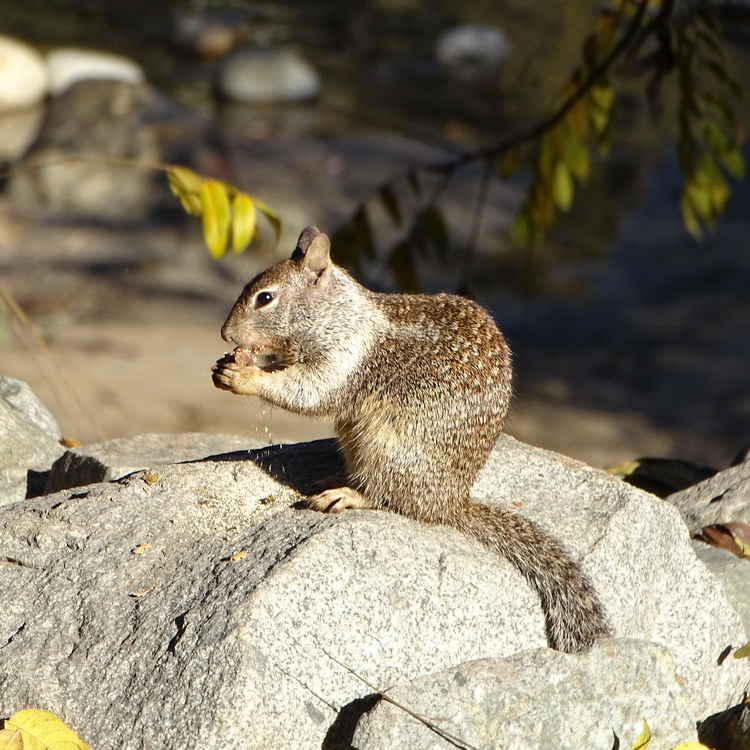


The California ground squirrel is common and easy to see in many areas. Their extensive burrow systems make them “ecosystem engineers” as they create homes for many other creatures to inhabit. Ground squirrels are gregarious and active during the day and can be distinguished from other squirrels by the white ring around their eye, speckled coat, and light gray shoulders.
What metrics determine the health of this indicator?
Metric 1
Maintain a significant percentage (more than 50% of park or land units) of Network partner lands with active ground squirrel colonies and the spatial extent of occupied habitat (aerial extent of active ground squirrel colonies) in grasslands is maintained or increased.
 Caution
Unknown
Low
Caution
Unknown
Low Metric 1
Maintain a significant percentage (more than 50% of park or land units) of Network partner lands with active ground squirrel colonies and the spatial extent of occupied habitat (aerial extent of active ground squirrel colonies) in grasslands is maintained or increased.
Geographic Area
Condition Thresholds
Good
Land units and/or parks in Network partner lands with ground squirrel detections maintain their presence within 50% of land units or parks. The number of occupied land units and/or parks (that is, with ground squirrels detected) in Network partner lands is increasing or stable.
Caution
Ground squirrels detected in fewer than 50%, but more than 20%, of land units or parks in Network partner lands. The number of land units and/or parks with ground squirrel detections decreases by 20% from one year to the next.
Significant Concern
Ground squirrels detected in fewer than 20% of land units and/or parks in Network partner lands. Also, currently active ground squirrel units (that is, with a documented ground squirrel presence) decrease by more than 50% from one year to the next.
Metric Current Health Findings
Current Condition
Current condition is Good based on the average of conditions below:
- Mt. Diablo Range, Mt. Hamilton: Good. More than 50% of the parks (or land units) have ground squirrel detections.
- East Bay Hills: Caution. Of 39 units, 31% have detections.
Current Trend
Current trend is Unknown. Three data points are needed to understand change over time. This year is the first, and only, data point we have for this metric.
Current Confidence
Current confidence is Low. Measurements were based on recent, reliable, and suitably comprehensive monitoring data. We queried each Network partner agency about ground squirrel detections over a period of months and augmented our findings with records from the camera studies, a ground squirrel research project conducted in 2021, and an iNaturalist project that specifically collected reliable ground squirrel records. However, we do not know the abundance or distribution of the ground squirrel population. In addition, this condition assessment relies on trends, and because we lack a time series, the confidence was “low” due to the missing trend data.
Rationale - Why It's Important
California ground squirrels provide ecosystem services to many taxa in the area of focus. Documenting their presence in each subregion ensures that this keystone species (important to ecosystem functioning) is able to continue to play that role.
Goal
- Maintain a significant percentage (more than 50% of park or land units) of Network partner lands with documented presence of a ground squirrel.
- The spatial extent of occupied habitat (areal extent of active ground squirrel colonies) in grasslands is maintained or increased.
Baseline Description
Current baseline conditions were determined based on information from Network partner agencies who were queried about ground squirrel presence records or observations within the past year for each of their land units or parks for each subregion in the area of focus. These findings were compiled into a table with ground squirrel locations for each park or land unit. To supplement this information, we included these sources:
- Aggregated ground squirrel camera trapping records from Network partner lands (land unit or park) and by subregion.
- A ground squirrel research study conducted in the spring of 2021 (Townsend and Lenihan 2021; Appendix H, Ground Squirrel Research Report), for which East Bay Regional Park District (EBRPD) parks were visited to document whether or not ground squirrels were present.
- An iNaturalist California ground squirrel project initiated in October 2020, which provided research-grade observations that we collated and cross-referenced to determine locations within parks and land units in Network partner lands in each subregion (iNaturalist, queried August 4, 2021).
Metric 2
Stable or increasing max counts and burrow density estimates in all sentinel sites in each subregion over three-year intervals.
 Unknown
Unknown
Unknown  Moderate
 Metric 2
Stable or increasing max counts and burrow density estimates in all sentinel sites in each subregion over three-year intervals.
Geographic Area
Condition Thresholds
Good
Ground squirrel counts and burrow density estimates are stable or increase for the majority of the sentinel sites and if there are decreases for one or both measures, they are not greater than 30%.
Caution
Ground squirrel counts and burrow density estimates decrease by more than 30% in both sentinel sites in any one subregion in the area of focus.
Significant Concern
Ground squirrel counts and burrow density estimates decrease by more than 50% in three or more of the six sentinel sites.
Metric Current Health Findings
Current Condition
Current condition is Unknown. This first year can serve as a benchmark as these sites were chosen for their robust ground squirrel activity. The “good” condition threshold is based on trend, which cannot be determined until we have at least three subsequent years data.
Current Trend
Current trend is Unknown. Additional years of data will provide trend information to determine if these sentinel sites remain stable.
Current Confidence
Current confidence is Moderate. Measurements in this first year were based on recent, reliable, and comprehensive survey data but the condition and trend could not be determined as this year is serving as benchmark for subsequent years.
Rationale - Why It's Important
To understand how ground squirrel populations are faring, particularly as climate change effects such as severe drought and wildfire are prevalent in the area of the focus, trends in ground squirrel abundance should be monitored using reliable, repeatable methods. For ground squirrels to persist on the landscape, healthy source populations need to be maintained. To ensure healthy source populations are present, some effort is needed to identify these populations and monitor them both to ensure they remain present on the landscape but also to indicate what may also be occurring in other nearby populations.
Goal
Stable or increasing maximum counts and burrow density estimates in all sentinel sites in each subregion over three-year intervals.
Baseline Description
At Morgan Territory (Mt. Diablo Range), Sunol (Mt. Hamilton), and Briones (East Bay Hills), more than 60% of burrows had fresh scat, while at the remainder of the sentinel sites—Brushy Peak (Mt. Diablo Range), Del Valle (Mt. Hamilton), and Garin (East Bay Hills)—less than 50% had fresh scat. Burrow attributes can indicate activity or inactivity; fresh scat, alarm calls, and the observation of a ground squirrel indicate likely active and, conversely, debris in an entrance may indicate inactivity. Burrows can persist on the landscape for variable periods of time depending on use, soil type, and soil moisture. Density estimates were reported for both burrows (single burrows) and burrow clusters (burrows clustered within five meters of one another).
Burrow density estimates/sq km (D) ranged from 6,852 at Brushy Peak (Mt. Diablo Range) to a high of 36,350 at Briones (East Bay Hills). Burrow cluster density estimates/sq km (DS) ranged from 3,405 (187–62,167; not included in Figure 12.3 due to the large confidence interval) at Brushy Peak and a 315 high of 9,230 at Garin (East Bay Hills). The Brushy Peak density estimate’s large confidence intervals can be remedied in future years by increasing the number of transects.
Metric 3
A portion of managed grazed grasslands have prescribed RDMs that meet targets within an acceptable range for ground squirrels (generally less than 800 lbs/acre).
Unknown
Unknown
Low Metric 3
A portion of managed grazed grasslands have prescribed RDMs that meet targets within an acceptable range for ground squirrels (generally less than 800 lbs/acre).
Geographic Area
Condition Thresholds
Good
Grazed grasslands with management plans in Network partner lands have RDMs compatible with ground squirrels and/or Rangeland Management Plans have RDMs set to be compatible with ground squirrels.
Caution
Grassland management is insufficient to maintain acceptable RDMs for ground squirrels on more than 50% of grassland in any one subregion.
Significant Concern
Grasslands in a significant portion (to be defined) of each subregion in the Network partner lands are not managed by adequate grazing, mowing, or burning.
Metric Current Health Findings
Current Condition
Current condition is Unknown. We have not analyzed the information on RDM and ground squirrel occupancy on grazed grasslands.
Current Trend
Current trend is Unknown. We have not analyzed information on RDM for grasslands over time.
Current Confidence
Current confidence is Low. Monitoring was not sufficiently recent, reliable, or comprehensive to assess condition.
Rationale - Why It's Important
Grassland habitat suitable to maintain a healthy ground squirrel population can be supported by mowing, burning, and grazing. California ground squirrels live in a spectrum of grassland conditions but are often found in grazed grasslands with low standing biomass. The absence of grazing can result in tall, dense grasses with high standing biomass which can be unsuitable habitat for grassland species, including ground squirrels.
Residual dry matter (RDM) monitoring developed by University of California scientists, is used by California land management agencies for assessing rangeland condition, protecting against erosion and adjusting stocking rates on grazed annual rangeland and associated savannas and woodlands. RDM is the dry, old herbaceous plant material remaining in fall, essentially mulch or litter left standing or on the ground at the beginning of a new growing season. It indicates the combined effects of the previous season’s forage production, breakdown over summer, and its consumption by grazing animals of all types (Bartolome et al. 2006). Setting RDM targets is an important task in California range management.
RDM targets can be used to manage herbaceous biomass for special-status grassland animal species, such as the San Joaquin kit fox, badger, and burrowing owl. Because ground squirrels are thought to prefer open areas with low, non-thatchy vegetation (Ricankova et al. 2006, Proulx et al. 2012, and Bylo et al. 2014), RDM data could, in theory, be used to assess which lands are consistent with their habitat preferences. Because RDM measures density rather than height and because the relationship between livestock and ground squirrels could be competitive in certain situations, particularly in less productive years (see also Fehmi et al. 2005; Cheng and Ritchie 2006; Proulx 2010 as cited in Bylo et al. 2014), this is an imperfect tool. However, these data are already collected over a significant portion of the study area, which may become useful if Metrics 1 and 2 show decline.
Goal
A portion of managed grazed grasslands have prescribed RDMs that meet targets within an acceptable range for ground squirrels (generally, presumed to be less than 800 lbs. per ac).
Baseline Description
RDM targets are often specified in Network partner agency monitoring plans and grazing licenses. Therefore, in theory, RDM targets and reporting could provide data useful for assessing habitat suitability. RDM targets were set and reported for Contra Costa Water District’s (CCWD) San Joaquin HMUs. For these lands, Los Vaqueros Watershed RDMs were above target (i.e., less suitable for ground squirrels) in the five HMUs. H. T. Harvey & Associates (2017) indicated that RDMs were above target in all HMUs except portions of Corral Hollow. EBPRD sets RDM targets of 1000 lbs/acre. These targets are typically met on EBRPD lands. The extent of managed rangelands with reported grassland RDM monitoring results for Network partner agencies was not determined.
About this Indicator
The California ground squirrel (Otospermophilus beecheyi) is a keystone species and ecosystem engineer that plays a critical role in ensuring that grassland fauna and flora thrive in the East Bay region (Davidson et al. 2012, Lenihan 2007, Swaisgood et al. 2019). Keystone species exert a disproportionate role on community structure relative to other species. Ecosystem engineers are those species that alter the environment in a way that increases habitat value for other species. In addition, ground squirrels serve as an important food resource, and various taxa such as invertebrates, amphibians, reptiles, and small mammals rely on their burrows for shelter. As ecosystem engineers, ground squirrels aerate the soil as they dig. In fact, in grassland ecosystems where similar species were observed to dig, increased local plant biodiversity and pollinator diversity and numbers have been documented (prairie dogs: Davidson et al. 2012; Siberian marmot: Yoshihara et al. 2010a, Yoshihara et al. 2010b) and increased soil moisture (gophers: Smallwood and Geng 1997).
Why is This Resource Included?
The California ground squirrel is an indicator of ecosystem health because it is a grassland keystone species and ecosystem engineer that plays a critical role in ensuring that grassland fauna and flora thrive in the East Bay region (Davidson et al. 2012, Lenihan 2007, Swaisgood et al. 2019). In addition, ground squirrels serve as an important food resource and various taxa rely on their burrows for shelter. Ground squirrel population health serves as an indicator for the health of the soils, plant communities, and the suite of species that benefits from its presence. Since many taxa are dependent on and benefit from ground squirrels, understanding their population health and monitoring them over time could help provide an early warning system regarding the effects of climate change on local populations.
Desired Condition and Trend
The desired condition and trend are that ground squirrels are present in at least 50% of Network partner lands (land units or parks) with grasslands in each subregion in the area of focus (Metric 1). Also, that ground squirrel abundance is stable or increasing in a majority of the sentinel sites (that is, established areas that are monitored on a regular basis) in each subregion (Metric 2). Finally, that grasslands suitable for the ground squirrel are maintained in the majority of Network partner lands (Metric 3).
Current Condition and Trend
Network partner lands consist largely of grasslands and other open habitat (e.g., oak woodland) suitable for ground squirrels. The area of focus includes 456 sq km of grasslands: East Bay Hills subregion, 112 sq km (36%); Mt. Diablo Range subregion, 197 sq km (52%); and Mt. Hamilton subregion, 147 sq km (63%) (habitat layers for area calculations were taken from CLN 2.0). Ground squirrels are considered widespread and patchy in their distribution in areas where they occur.
Ground squirrel studies have been conducted over the years in parts of the area of focus, but no recent comprehensive assessment of their status over a large geographic area exists (although, see Townsend and Lenihan 2021, Appendix H, Ground Squirrel Research Report). However, recent severe drought conditions and wildfires are likely affecting the numbers and areal extent of their presence. Some evidence suggests that this species is on the decline (see studies cited in later in this chapter as well as anecdotal observations by researchers); however, to date, we do not clearly understand whether this species’ population is increasing, decreasing, or stable or if its range is shrinking or expanding. Furthermore, due to the differences between the subregions (such as ruggedness, mosaic of habitats, aspect, soils, level of development, land use, and even local climatological differences), ground squirrels’ condition and trends may vary between them.
Lenihan (2002–2004) documented several stable ground squirrel populations in five study sites in the Mt. Diablo Range and Mt. Hamilton subregions. Of these, four included Network partner lands in San Antonio Reservoir (two sites), Brushy Peak, and Vasco Caves (Lenihan 2007). Ground squirrel densities were estimated at 23 to 29 individuals per hectare (ha). Historical density estimates were reported at 50 to 190 individuals/ha, with more recent estimates at 11 to 39 individuals/ha (see Lenihan 2007 for discussion and citations). These estimates indicate that the ground squirrel’s current presence and density are well below historical numbers. Monitoring results from Contra Costa Water District’s (CCWD) Habitat Management Units (HMUs) in the Mt. Diablo Range and Mt. Hamilton subregions showed stable trends from 1998 to 2006. However, Smallwood (2014) observed declines in the density of ground squirrel burrow complexes at Vasco Caves (Mt. Diablo Range subregion) from 2006 to 2014, noting declines in both grazed and ungrazed areas.
In the spring and early summer of 2021, a study—“California Ground Squirrel Presence, Aerial Extent (Active), and Abundance Within the East Bay Regional Park District Lands in the Area of Focus for the Ecological Health Assessment for the East Bay Stewardship Network” —was conducted to augment our existing understanding of ground squirrel presence for some of the Network partner lands; work included visiting parks to note presence (Metric 1) and to establish baselines for selected sentinel sites to be surveyed annually (Metric 2). The current condition, trend, and confidence are the average of the condition, trend, and confidence for the ground squirrel in each subregion. The suite of metrics was combined to obtain this current condition and trend. These metrics are how we are measuring the difference between what is described in this section (i.e., how things are now) and the desired condition and trend in the preceding section (i.e., what we think “healthy” is for this indicator).
Stressors
Climate Change
Increased drying and drought conditions may affect the carrying capacity of grassland ecosystems. Small, isolated ground squirrel populations would be more vulnerable to extirpation under these conditions.
Direct Human Impacts
Poisoning ground squirrels is common and variably regulated. Ground squirrel eradication efforts continue, particularly to protect infrastructure such as levees and crops. Other reasons for poisoning include maintaining lawns and other landscaped areas. Because they have no formal protection, no effort is made to avoid ground squirrel burrows during activities that cause ground disturbance unless listed species that use their burrows may be present.
Disease
Ground squirrels are susceptible to outbreaks of bubonic plague, which is 100% lethal for them and causes periodic die-offs.
Fire Regime Change
Temporary disruption to life history may result from fire (lack of forage, for example); however, wildfires likely enhance grassland habitat for ground squirrels. Fire can be used to enhance grasslands for a number of reasons, such as reducing woody forbs, dried vegetation, or tall thatch, as well as increasing forage-nutrient availability. All these could also be considered enhancements for the California ground squirrel.
Historical Impacts
Because poisoning and other eradication efforts have been underway for decades, this species has likely been extirpated from much of its former range. In particular, widespread eradication programs undertaken in Contra Costa and Alameda Counties have affected this species within the area of focus. Control programs reduced most populations to below carrying capacity (Marsh 1987), with some local populations reduced by 90% to 95% (Hunt et al. 1995). Alteration and loss of grassland habitat as a result of the introduction of non-native grasses, as well as infrastructure and development in the region over time, have likely also had a long-term degrading effect on ground squirrel distribution and populations. It is important to note that this species remains the target of unregulated eradication efforts to protect infrastructure, crops, and landscaped areas (see Direct Human Impacts).
Additional Resources
Other Metrics Considered but Not Included
Ground squirrel density estimates (low, moderate, and high) in occupied areas could provide a metric to convert density and area occupied into number of individuals. The advantage of this approach would be to estimate populations (see Townsend and Zahler 2005 for an example of this approach). The density estimate would assign a number of ground squirrels for a given unit of area; for example, published estimates of density include low = 11/ha, moderate = 40/ha, and high = 50/ha. This approach could then provide several metrics (presence, density, and population estimate) for a given area. For example, the desired condition would be present in at least 75% of the units in each subregion that supports grasslands, and at moderate density in at least 50% of the units in each subregion. Finally, population estimates could be derived from areas where size and density are known. This metric was not chosen because we lacked the data, funding, and time to complete it.
Data Gaps and Data Collection/Management Needs
- RDM may not be the best tool for measuring habitat suitability for grassland wildlife species because: 1) it is designed to measure forage availability, not grassland height; 2) Typically, one RDM measurement is taken for an area ranging from 50–200 acres and therefore does not provide high resolution and; 3) A portion of Network partner lands are not grazed and therefore RDM targets are not collected or monitored in those areas so it would not be possible to measure their habitat suitability with this method.
- Surveys of ground squirrel abundance at sentinel sites have only been conducted for one year, 2021, which experienced below-average rainfall. Additional years of research are needed to capture years with more normal precipitation levels and to quantify how variation in precipitation and the onset of drought conditions might impact the local ground squirrel populations.
- Unprocessed images from camera efforts that have ground squirrels recorded and acoustic files from audiomoths need to be processed, collated, and used to update these metrics.
- Refine Metric 1 to assist with identifying ground squirrel distribution and abundance in suitable habitats.
Past and Current Management
Several ongoing monitoring requirements limited to CCWD’s Los Vaqueros Reservoir and Los Vaqueros Expansion mitigation lands require(d) prey assessment by estimating the percentage of active areas for San Joaquin kit fox prey species, including ground squirrels (potential and active burrows, Mitigation and Monitoring and Habitat Management Plan for the Los Vaqueros Reservoir Expansion). Monitored sites included the following in the Los Vaqueros Watershed (1998–2016), Mt. Diablo Range subregion: Marsh Creek (998 acres [ac hereafter]), Los Vaqueros (80 ac), Morgan Territory (329 ac), Altamont (651 ac), and Corral Hollow (3,021 ac). As part of this effort, a six-year dataset included 15 study plots showing mostly stable ground squirrel populations (Sterner 2007).
Smallwood (2014), who monitored ground squirrel burrow complexes at the Vasco Caves in different grazing regimes from 2006 to 2014, noted declines in both grazed and ungrazed areas.
As described previously, a study conducted in early summer 2021 on the areal extent of ground squirrel presence and abundance was undertaken to augment existing information about the species’ current condition on EBRPD lands, and, in part, also to understand the possible impacts of climate change on this species. This sentinel site study evaluated two locations from each subregion for a total of six sites. As part of the study, sentinel sites were selected and methods for estimating abundance were used to establish baseline and current conditions of the ground squirrel for metrics (Townsend and Lenihan 2021).
Post-fire monitoring (using camera traps and acoustic sensors) that began in November 2020 is collecting data on ground squirrels, however those data were not evaluated in time to be included in this analysis. Seasonal occupancy estimates will provide abundance estimates to compare over time for trends in burned and unburned lands (Los Vaqueros Watershed [CCWD], Morgan Territory and Round Valley [EBRPD]). A range ecology grassland management and monitoring report based on 10 years of grassland botanical assessments and bird monitoring (Bartolome et al. 2011) was prepared for lands in the area of focus. RDM recommendations were not included as part of this assessment; range management recommendations focused on maintaining and enhancing native-plant and grassland-bird abundance, controlling invasive plant species, and understanding and managing the effects of grazing on native plants and grassland bird populations. The degree to which these recommendations are consistent with, rather than deleterious to, the presence of burrowing mammals was not assessed but could provide insight into how management recommendations may be promoting or inhibiting ground squirrel presence on the landscape as far as “grassland suitability” (see Potential Future Actions). The majority of Network partner agency landowners prohibit the use of rodenticides in its grazing areas, watersheds and wildlands. However, private landowners may be using rodenticide on their properties.
Potential Future Actions
- Determine a method to measure current grassland health and suitability across the area of focus for wildlife species, such as the ground squirrel and monitor suitability through time.
- Aggregate ground squirrel research and surveys on Network partner lands into a document database to provide more information on ground squirrel distribution across the landscape through time.
- Use acoustic monitoring (e.g., AudioMoths) to include ground squirrel calls in addition to bird monitoring.
- Develop a database for Network partners to share presence/absence data and records (observations with location, date, time, and photograph if possible) to improve the specificity of ground squirrel presence data.
- Develop a public education program for neighboring landowners on the importance of ground squirrels in maintaining grassland health and biodiversity.
Key Literature and Data Sources
For additional information about this indicator including key literature and data sources see NatureCheck